
GOSPEL MEDITATION - ENCOURAGE DEEPER UNDERSTANDING OF SCRIPTURE

July 5, 2026

Fourteenth Sunday in Ordinary Time

Matthew 11:25-30

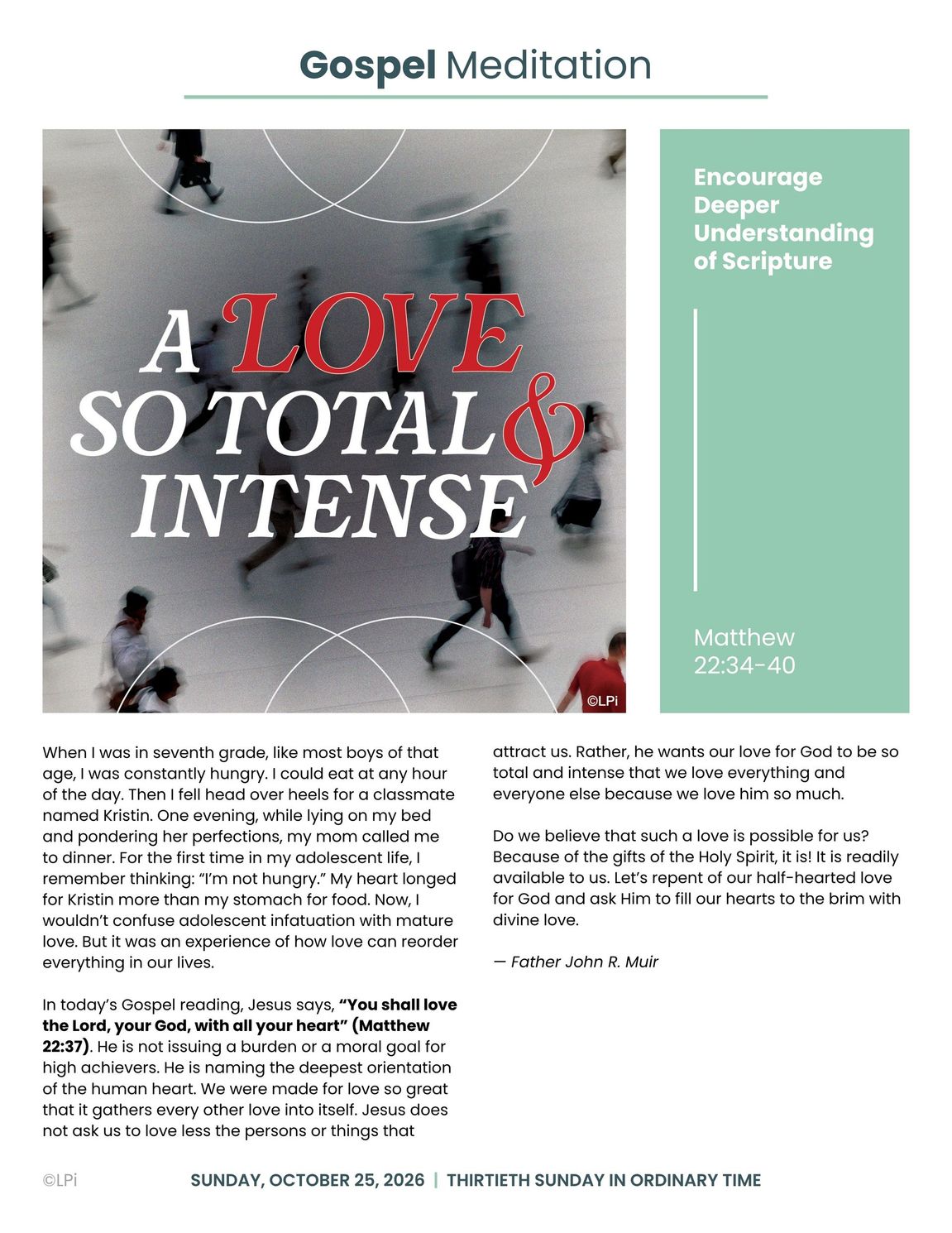
This weekend, our nation celebrates the 250th anniversary of the signing of the Declaration of Independence. Unlike most nations, the United States was not founded primarily on a shared ethnicity, language, or culture. Instead, our founders built a political community out of diverse peoples united by a shared vision of liberty. That vision echoes something deep in the Christian mystery revealed in today’s Gospel.

Jesus returns to his hometown. The people see only what is familiar: the carpenter, the son of Mary, one of their own. As Mark tells us, “They took offense at him. Jesus said, ‘A prophet is not without honor except in his native place and among his own kin and in his own house.’” Their narrow vision blinds them. Jesus has come to inaugurate a new communion that transcends geography, bloodlines, and culture. He has come to unite all people in himself.

At its best, America’s national unity reflects this possibility, which fully subsists only in the Catholic Church. Our unity is not based on ancestry or tribe, but on a shared commitment to higher ideals. For this reason, we can love our country with gratitude while situating patriotism within the broader horizon of faith.

Rooted in Christ, we are less vulnerable to the unholy tribalism that threatens civic life and faith. This weekend, let us thank God for our nation and pray that we also live as citizens of Heaven in Jesus Christ.

— Father John Muir


PRAYER – FOR EVERYDAY AND EVERYBODY


Blessing for Rest

O God,

As You rested after the creation of the world,

remind us to take a sacred pause, too.

Surround and support us with Your love,

help us to practice holy rest — a practice that renews and recreates.

Amen.


(PRACTICING) CATHOLIC - RECOGNIZE GOD IN YOUR ORDINARY MOMENTS

By Colleen Jurkiewicz Dorman


The Smallness of Great Faith

My children attend Catechesis of the Good Shepherd (CGS) for their faith formation. Because of its Montessori basis, CGS atriums, which are something like classrooms, contain lots of objects made from real materials — authentic glass, wood, and ceramic.

This is a polite way of saying there are lots of breakable things in there.

So when my four-year-old entered the atrium on her first day of CGS, my whole body tensed, wondering what she would shatter first. I had to restrain myself from crying out, “Don’t touch anything!” She spotted the prayer table — the low, wooden stand which holds an open Bible, candles, a vase with flowers and a statue of the Good Shepherd. It’s the centerpiece of every atrium.

She knelt before the table. She made the sign of the cross. And she sat there, still and silent.

I stopped dead in my tracks. How had she known to come here? And where did she learn to make the sign of the cross? (Obviously we’ve tried to teach her, but she does it wrong every time!) And why was she sitting there so quietly, so expectantly, in front of a book she can’t read?

A thought came to me so clearly: Well, Colleen, you can read that book. But can you understand it?

It is so easy for us to forget that great faith does not require great intelligence. It does not require great knowledge of the world and its workings. Great faith does not require the believer to possess any answers.

Great faith only requires the believer to know his own smallness.


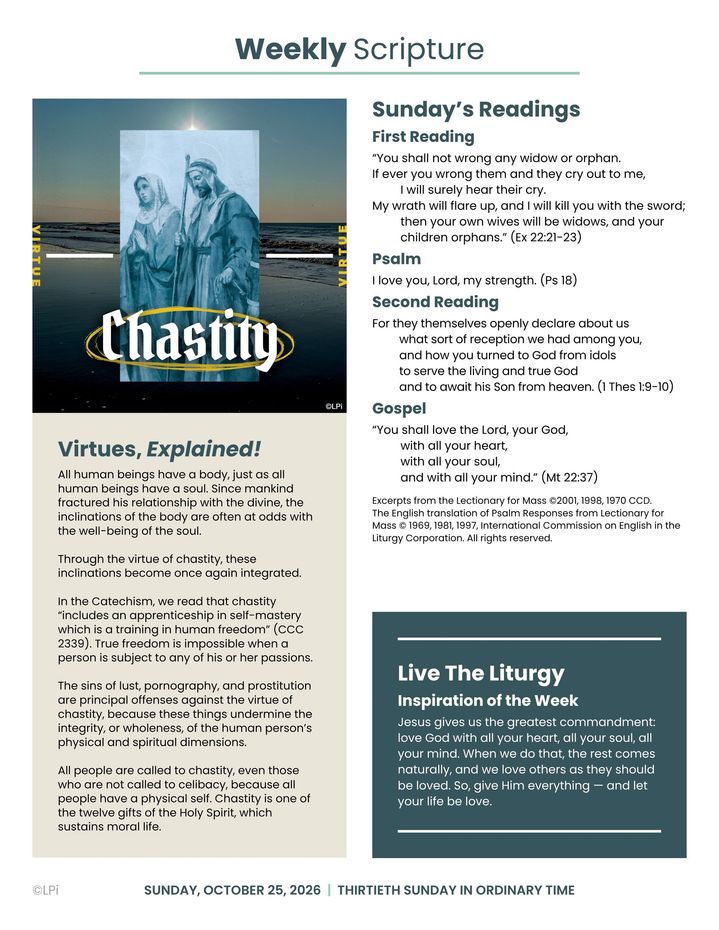
Virtues, Explained! Affability


There was a certain sister in the Carmelite convent who particularly tried the patience of St. Therese of Lisieux.

But instead of avoiding this person, St. Therese instead made a point of smiling at her whenever the two met.

“Charity must not consist in feelings, but in works,” wrote St. Therese. “I set myself to doing for this Sister what I would do for the person I loved the most.” In doing so, she learned to see “Jesus hidden in the depths” of this woman’s soul.

St. Therese was growing in the virtue of affability when she did this. Affability is attached to justice, writes St. Thomas Aquinas, and demands “that we behave pleasantly to those among whom we dwell.” (Sum., II:II, 114, Art. 2)

In being affable, we make ourselves friendly, approachable, and agreeable to those around us, regardless of how they make us feel. “How good and how pleasant it is when brothers dwell together as one,” writes King David in Psalm 133.


WELCOME ONE AND ALL TO NORTH AMERICAN MARTYRS PARISH

Our Mission Statement:

We, the North American Martyrs Parish, a strong community of faith, Nourished by the Holy Eucharist, Guided by the Holy Spirit and Trusting in the grace of God, Dedicate ourselves to live God’s Word and Let the light of Christ shine through our Community. We strive to provide sound religious formation for people of all ages; To care for the spiritual, social well-being of one another With particular attention to the stranger and the poor in our midst.


“As the Father has sent me, so I send you.’ John 20:21

Upcoming Events

MAKE PLANS TO JOIN US AT ONE OF OUR CEMETERIES ON AUGUST 1ST AT 6PM AS WE PRAY FOR THE REPOSE OF THE SOULS OF OUR LOST ONES.

ST ALBERT ------ ST BRENDAN ------ ST PIUS X